

Car Audio by Vehicle: Find Your Fit
One of the most common mistakes people make when buying car audio is shopping for equipment without thinking about their specific vehicle first. The head unit that fits perfectly in a Tacoma might not be the same one that fits in a Honda Civic. The subwoofer setup that works great in a full size truck cab is a completely different conversation than what works in the trunk of a sedan. Your vehicle shapes every decision in a car audio build, from what fits physically to what integrates with your factory systems to how much space you have to work with.
This page is your starting point. Find your vehicle type below and we will point you toward the guides, products, and considerations that are most relevant to your specific build.
Why Your Vehicle Matters More Than You Think
Every vehicle presents a unique set of challenges and opportunities when it comes to audio. Dash opening size determines which head units will fit. Door depth and speaker mounting locations determine which speaker sizes and designs work. Cargo space determines what kind of subwoofer setup is realistic. Factory system complexity determines how involved the integration process needs to be.
Some vehicles are straightforward to work with. Pull the factory unit, drop in an aftermarket head unit with a standard harness adapter, swap the door speakers, add a sub in the trunk, done. Other vehicles have complex factory amplified systems, non-standard dash openings, or CANBUS architecture that requires additional integration modules to make everything work correctly.
Knowing what you are dealing with before you buy saves you time, money, and frustration. That is exactly what the guides on this page are designed to do.
Trucks
Trucks are one of the most popular vehicle categories in car audio and for good reason. They tend to have generous cab space, large door panels that accommodate bigger speakers, and in the case of crew cabs, real trunk equivalent space behind the rear seat for a subwoofer setup. Truck owners also tend to be serious about their audio, which means the aftermarket support for popular truck models is extensive.
The most common considerations for truck builds are speaker sizing in the front doors, which varies significantly between models and trim levels, subwoofer placement options including behind the seat and in the bed, and factory system integration for trucks that came with premium audio packages from the factory.
San Diego has one of the highest concentrations of truck owners of any major city in the country. Tacomas, Tundras, F-150s, Silverados, and Rams are everywhere and our install team has built systems in all of them more times than we can count.
Best car audio for Toyota Tacoma
Best car audio for Toyota Tundra
Best car audio for Ford F-150
Best car audio for Chevy Silverado
Best car audio for Ram 1500
Best car audio for GMC Sierra
SUVs and Crossovers
SUVs and crossovers present a unique opportunity in car audio because of their enclosed cargo area. Unlike a sedan trunk which is separated from the cabin by a rear seat, most SUVs have an open cargo area that connects directly to the passenger space. This means a subwoofer in the back of an SUV fills the entire cabin with bass rather than trying to push sound through a rear seat. The result is typically more impactful, more enveloping low end than you get in most other vehicle types.
The challenge with SUVs is that many of them come with factory premium audio systems as standard or optional equipment. Brands like BOSE, JBL, Harman Kardon, and Bang and Olufsen are common in this category and each requires specific integration approaches to upgrade properly.
Best car audio for Jeep Wrangler
Best car audio for Toyota 4Runner
Best car audio for Honda CR-V
Best car audio for Ford Explorer
Best car audio for Subaru Outback
Best car audio for Chevrolet Tahoe
Cars and Sedans
Sedans and coupes are the most common vehicle type on the road and they have their own set of audio considerations. The trunk is separated from the cabin which means subwoofer bass has to travel through the rear seat to reach your ears. Foldable rear seats help significantly with this, and in many sedans folding the rear seats down turns a mediocre subwoofer setup into an excellent one.
Speaker sizing in sedans tends to be more constrained than in trucks and SUVs, with many models using 6.5 inch or smaller drivers in the doors. Dashboard real estate is also more limited in older sedans, though most vehicles from the mid 2000s onward accommodate a standard double DIN head unit with the right dash kit.
One category worth paying attention to for sedans is shallow mount subwoofers. Many sedan trunks are smaller than you think once you account for the spare tire well, and a shallow mount sub in a slim enclosure can deliver impressive bass without consuming the entire trunk.
Best car audio for Honda Civic
Best car audio for Honda Accord
Best car audio for Toyota Camry
Best car audio for Subaru WRX
Best car audio for Ford Mustang
Best car audio for Dodge Charger and Challenger
Shallow mount subwoofers: full guide
Jeeps
Jeeps deserve their own section because they are genuinely unlike any other vehicle category in car audio. The open air nature of a Wrangler or Gladiator means audio equipment is exposed to the elements in a way that nothing else on this list comes close to. Rain, dust, UV exposure, and mud are regular occurrences for Jeep owners who use their vehicles the way they were designed to be used.
The right approach for a Jeep build borrows heavily from marine audio. Marine grade speakers with UV stabilized materials and rubber surrounds, waterproof or water resistant head units, and sealed or conformal coated amplifiers are what hold up in this environment. A standard car audio build in a Jeep will look fine on day one and start failing within a season.
The other Jeep specific consideration is sound bar systems. Many Wrangler owners opt for a dedicated Jeep sound bar that mounts in the factory location above the windshield, providing clean speaker placement without complicated custom fabrication.
All of that said, the weatherproofing consideration only applies if you are regularly driving with the top off. If you keep your Jeep fully enclosed most of the time, you can approach the build the same way you would any other vehicle and standard car audio components will hold up just fine. The marine grade recommendation is specifically for owners who spend real time open air, whether that is on the trail, the beach, or just cruising around San Diego on a nice day.
Best car audio for Jeep Wrangler
Best audio for Jeep Wrangler: weatherproof setup
Marine audio: the complete guide
Powersports and Off-Road Vehicles
Beyond traditional passenger vehicles, a growing number of our customers are building audio systems for UTVs, ATVs, side by sides, and other off-road vehicles. This category has exploded in popularity and the products available for it have grown significantly to match.
Powersports audio has even more demanding environmental requirements than Jeep builds. Dust, vibration, UV exposure, and mud are constant factors and the equipment needs to be built for all of them. Purpose-built powersports audio components from brands like Rockford Fosgate and JL Audio are designed specifically for these vehicles and include mounting solutions, weatherproofing, and power handling that match what these environments demand.
Marine audio: the complete guide
Vehicles with Factory Premium Audio Systems
A growing number of vehicles across all categories come from the factory with premium branded audio systems. BOSE, JBL, Harman Kardon, Bang and Olufsen, and Mark Levinson are some of the most common names you will see. These systems use factory amplifiers integrated into the vehicle's electrical architecture, non-standard speaker impedances, and in many cases signal processing built into the head unit or a separate DSP module.
The good news is that none of this makes upgrading impossible. It just requires a different approach than a standard install. Depending on your goals and your vehicle you have a few options.
The first option is full replacement using an integration module like iDatalink Maestro to allow an aftermarket head unit to communicate with the factory systems while preserving features like steering wheel controls and backup cameras. This is the cleanest solution if you want to replace the head unit entirely.
The second option is keeping the factory head unit in place and upgrading everything downstream. A line output converter or a processor like those from AudioControl or JL Audio can tap the factory amplified signal, correct for any factory equalization, and send a clean signal to aftermarket amplifiers and speakers. This approach works extremely well and avoids the complexity of replacing a factory head unit in a vehicle that was not designed to have it replaced easily.
How to upgrade a BOSE car audio system
How to upgrade a JBL factory system
How to keep your factory head unit and still upgrade your sound
What is a line output converter?
How to Find the Right Fit for Your Vehicle
If your specific vehicle is not listed in the guides above yet, here is how to think through the key questions yourself:
What size head unit does your dash accept? Measure your current opening or look up your year, make, model, and trim in our fitment guide. Single DIN and double DIN are the two standard sizes but some vehicles use non-standard openings that require specific dash kits.
What speaker sizes does your vehicle use from the factory? Again, a fitment guide for your specific vehicle will tell you the factory speaker locations and sizes. This determines which aftermarket speakers will drop in without modification.
Does your vehicle have a factory amplified audio system? Check your owner's manual or look up your trim level. If your vehicle came with a premium audio package by name, it almost certainly has a factory amplifier somewhere in the system that needs to be accounted for in the upgrade plan.
How much space do you have for a subwoofer? Measure your trunk or cargo area with the spare tire and any storage structures accounted for. This determines whether a standard enclosure, a loaded enclosure, or a slim shallow mount setup is the right call.
If you work through those four questions and still have questions about your specific vehicle, reach out. Our install team has worked on virtually every make and model that drives through San Diego and we can give you a straight answer about what works and what does not for your specific situation.
Car stereos and head units: the complete guide
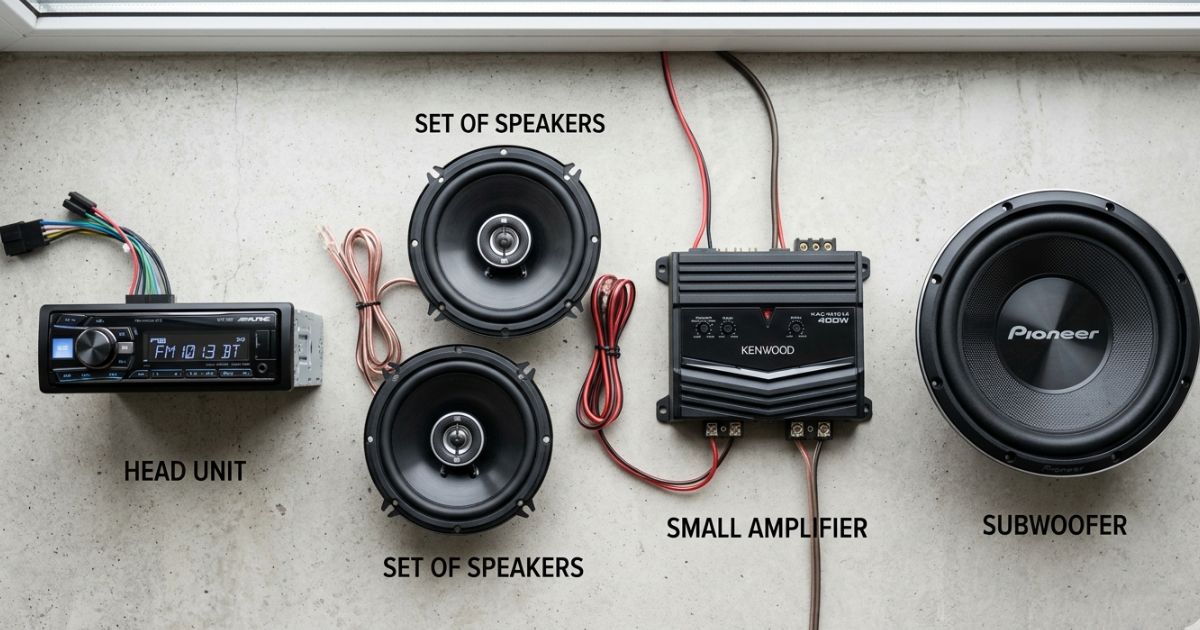
Car speakers: the complete buying guide
Subwoofers: the complete buying guide
Car amplifiers: the complete guide
Frequently Asked Questions
Does my vehicle need a special dash kit for an aftermarket head unit? Almost always yes. Dash kits are vehicle specific trim pieces that fill the gap around an aftermarket head unit and make the install look factory clean. They are inexpensive and widely available for most vehicles. Your installer will know exactly which one you need or you can look it up by year, make, model, and trim.
Will an aftermarket head unit work with my steering wheel controls? Yes with the right interface module. Brands like iDatalink Maestro, Axxess, and PAC make steering wheel control interfaces for most vehicles that allow your factory steering wheel buttons to control the aftermarket head unit. A good installer includes this in every build automatically.
Can I upgrade my audio without replacing my factory head unit? Yes and in many vehicles this is actually the preferred approach. Adding an amplifier, upgraded speakers, and a subwoofer while keeping the factory head unit in place is a common and very effective upgrade path. A line output converter or signal processor handles the integration between the factory system and the new components.
My vehicle has a large factory touchscreen. Can I still upgrade the audio? Yes. Vehicles with large integrated factory screens, like many newer Fords, GMs, and Toyotas, are often best served by keeping the screen in place and upgrading the audio components downstream. An aftermarket amplifier and speakers combined with a processor that corrects the factory signal can transform how these systems sound without touching the factory screen.
How to keep your factory head unit and still upgrade your sound
Get the Right System for Your Vehicle
Every vehicle is different and the right audio setup for your car, truck, or SUV depends on factors that are specific to you: your vehicle, your goals, your budget, and how much of your trunk or cargo space you are willing to work with. Our install team has built systems across virtually every make and model and we are happy to walk you through exactly what makes sense for your situation.


Leave a comment
All comments are moderated before being published.
This site is protected by hCaptcha and the hCaptcha Privacy Policy and Terms of Service apply.