
Car Audio for Beginners: The Complete Guide
At some point the factory stereo stops being good enough. Maybe your speakers are starting to distort. Maybe you get in a friend's car and realize how much better sound can actually be. Maybe you have just been putting it off for years and you are finally ready to do something about it.
Whatever got you here, this guide is the place to start. We are going to walk you through everything you need to know from the ground up: what the different components do, what the specs actually mean, how they work together, and how to figure out what your specific vehicle needs. No assumptions, no jargon without explanation, just a clear path from factory sound to something you are actually proud of.
The Four Main Components of a Car Audio System
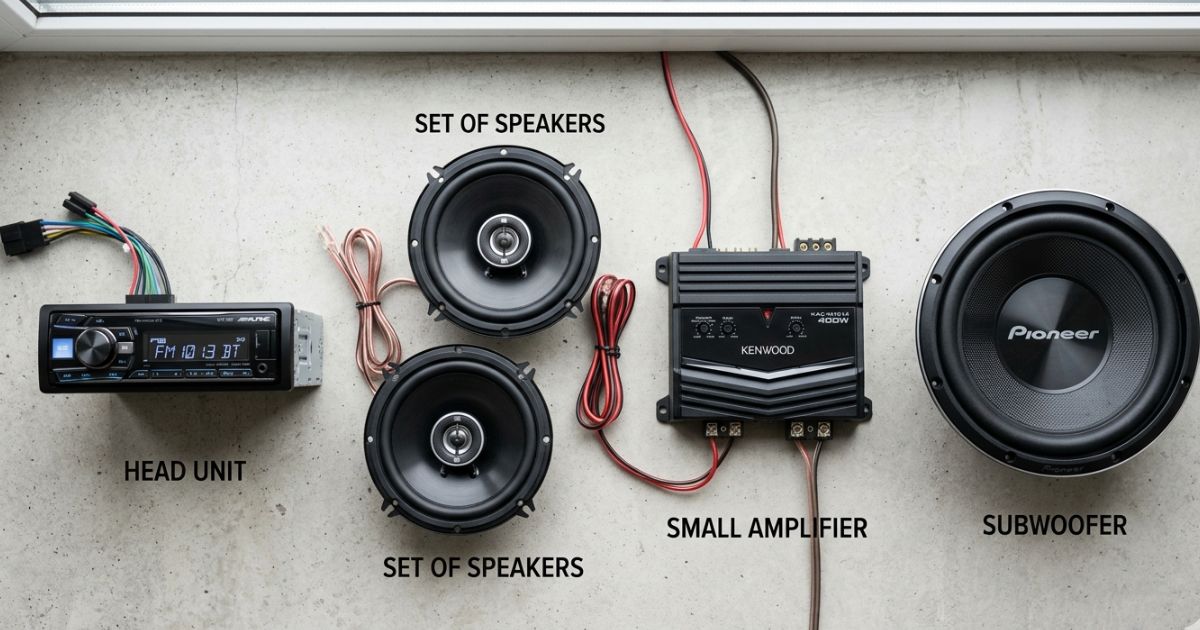
A car audio system has four core building blocks. Understanding what each one does and how they relate to each other is the foundation of every decision you are going to make.
The Head Unit
The head unit is the stereo in your dashboard. It is the control center of the entire system. It handles your audio sources, whether that is Bluetooth from your phone, Apple CarPlay, Android Auto, AM/FM radio, or a USB connection, and it sends that audio signal out to everything else in the system.
Most people start here when upgrading their audio and for good reason. The factory head unit in most vehicles is built to a minimum standard. Replacing it with an aftermarket unit gives you better sound quality from the source, more connection options, a better interface, and critically, stronger signal outputs that make everything downstream perform better.
Car stereos and head units: the complete guide
The Speakers
Speakers are what actually produce the sound you hear. Your vehicle has speaker locations built into the doors, the rear deck, and sometimes the dash or A-pillars. Factory speakers are almost universally built to a budget, using cheap materials that produce mediocre sound and degrade over time.
Aftermarket speakers use better cone materials, stronger magnets, and more refined designs that produce noticeably more detail, clarity, and volume. Replacing your factory speakers is one of the most immediately noticeable upgrades you can make.
Car speakers: the complete buying guide
The Amplifier
An amplifier takes the audio signal from your head unit and multiplies its power before sending it to your speakers or subwoofer. Your head unit has a small amplifier built in but it is weak, typically producing 15 to 22 watts of real usable power per channel. That is enough to make sound come out of your speakers but not enough to make them perform anywhere close to their potential.
A dedicated external amplifier gives your speakers real power, which translates to more volume, more headroom, and dramatically less distortion at higher listening levels. If you have ever turned up your stereo and noticed it starts sounding harsh before it gets as loud as you want, that is your factory amplifier running out of clean power.
[LINK: Car amplifiers: the complete guide]
The Subwoofer
A subwoofer is a dedicated speaker built specifically to reproduce low frequencies, the bass in music. Your door speakers are physically not capable of producing real bass, they are not designed for it. A subwoofer fills in everything below what your door speakers can handle and gives music its weight, impact, and depth.
Adding a subwoofer to a system is one of the most transformative upgrades you can make. Music that felt flat suddenly has dimension. Kick drums hit the way they were recorded. Bass lines have body. It is not just about being loud, it is about hearing the full range of the music.
Subwoofers: the complete buying guide
How the Components Work Together
Understanding how these four pieces connect is important because they do not work in isolation. They are a system and the decisions you make about one affect the others.
The signal starts at the head unit. The head unit processes your audio source and sends a line level signal through RCA cables to your amplifier. The amplifier boosts that signal and sends the amplified output to your speakers and subwoofer. The subwoofer lives in an enclosure that shapes how it sounds and performs.
The head unit's job is to be a clean, strong signal source. The amplifier's job is to multiply that signal with power. The speakers' and subwoofer's job is to convert that electrical signal into sound. Each component depends on the one before it doing its job well.
This is why cheap components early in the chain hurt everything downstream. A head unit with weak preamp outputs sends a noisy signal to the amp. The amp amplifies that noise along with the music. No matter how good your speakers are, they cannot fix a bad signal coming in.
The Specs You Actually Need to Understand
Car audio is full of numbers and not all of them matter equally. Here are the ones worth paying attention to:
RMS Power
RMS stands for root mean square and it represents the continuous, usable power a component can produce or handle. This is the only power number that matters. Every other power rating, peak power, max power, burst power, is a marketing number that tells you nothing useful about real world performance.
When you are matching an amplifier to a speaker or subwoofer, use the RMS ratings on both. Match the amplifier's RMS output to the speaker's RMS handling and you are in good shape.
What is RMS in car audio?
Impedance
Impedance is the electrical resistance of a speaker, measured in ohms. Most car speakers are 4 ohm. This number matters because it affects how much power your amplifier produces and whether the amplifier is being asked to do something it is not designed to handle.
The practical takeaway for a beginner is to make sure your amplifier is rated to drive the impedance of the speakers or subwoofer you are connecting to it. Your installer will handle this automatically but if you are researching on your own, matching impedances is important.
What is impedance in car audio?
Sensitivity
Sensitivity tells you how loud a speaker will be given a specific amount of power. It is measured in decibels. A speaker rated at 92dB will be noticeably louder than one rated at 88dB when both receive the same amount of power.
If you are running your speakers off a head unit without an external amplifier, higher sensitivity speakers will give you more volume from the limited power available. If you are running a dedicated amplifier, sensitivity matters less because you have power to spare.
What is sensitivity rating in speakers?
Frequency Response
Frequency response tells you the range of audio frequencies a component can reproduce. It is measured in hertz, abbreviated Hz. Human hearing covers roughly 20 Hz to 20,000 Hz. Lower numbers on the bass end mean deeper bass. Higher numbers on the treble end mean more high frequency detail.
Your door speakers handle the midrange and high frequencies. Your subwoofer handles the low frequencies. Together they cover the full range. A crossover, either built into your amplifier or in a component speaker set, divides the signal and makes sure each driver only receives the frequencies it was designed to handle.
What is a crossover in car audio?
Where to Start: Choosing Your First Upgrade
This is the question everyone has and the answer depends on what is bothering you most about your current sound.
If your factory speakers are blown, distorting, or just sound dull and lifeless, start with speakers. A quality set of aftermarket coaxial speakers in your door locations will make an immediate and obvious difference in clarity and detail. This is the easiest upgrade, the most affordable entry point, and something you will notice every single time you get in the car.
If your head unit feels outdated, lacks Apple CarPlay or Android Auto, or has weak Bluetooth, start with the head unit. A modern head unit transforms the daily driving experience, connects cleanly to your phone, and provides the strong signal foundation that makes every other upgrade you add later perform better.
If your music feels flat and thin and you want more impact, start thinking about a subwoofer. Even a modest subwoofer setup from a quality brand will change how your music feels in a way that speakers alone cannot achieve. Bass is the emotional foundation of most music and a system without a subwoofer is missing a significant part of the picture.
If you want to do everything right from the start, here is the order that makes the most sense: head unit first, then speakers, then amplifier and subwoofer. Each step builds on the previous one and nothing you buy early in the process becomes obsolete when you add the next piece.
How to plan a car audio upgrade
Understanding Your Budget
One of the biggest misconceptions in car audio is that you need to spend a lot of money to get a meaningful result. That is not true. Here is a realistic breakdown of what different budgets can accomplish:
Under $300 gets you a quality aftermarket head unit with Apple CarPlay and Android Auto, or a solid set of replacement door speakers from a reputable brand. Either upgrade on its own will noticeably improve your daily driving experience over factory equipment.
$300 to $600 gets you a good head unit and a quality set of door speakers together, which is a genuinely complete basic upgrade. At this level your system will sound significantly better than factory in every measurable way.
$600 to $1,000 gets you everything above plus a modest subwoofer and amplifier setup. This is where the system starts to feel complete. Real bass, clear midrange, crisp highs, and enough power to fill any vehicle.
$1,000 and up is where you start choosing premium components in each category, running dedicated amplification for your speakers as well as your subwoofer, and getting into territory where the results are genuinely impressive rather than just good.
The most important thing at any budget is to spend it on quality components in the right order rather than spreading it thin across everything at once. A single great speaker upgrade beats four mediocre ones every time.
DIY or Professional Installation?
This is a question worth being honest about before you start buying equipment.
Speaker replacements and basic head unit swaps are genuinely approachable for someone who is patient, methodical, and willing to follow instructions carefully. The tools are not expensive and the information is available. If you are the type of person who likes figuring out how things work and does not mind spending an afternoon on it, these are good starting DIY projects.
Amplifier and subwoofer installations involve running power wire from the battery, making clean ground connections, and routing signal cables correctly. They are not beyond a capable DIYer but they require more planning, more tools, and more knowledge of what can go wrong. A poorly done amplifier install can cause electrical noise, blown fuses, or in extreme cases electrical damage.
If you are not sure, a professional installation from a shop that knows what they are doing is worth the cost. Beyond just saving you time and frustration, a professional install is done correctly the first time, everything is secured properly, and the work is backed by the shop. For most people building their first real system, having the install done professionally means the system performs the way it was designed to from day one.
Car audio installation: the complete guide
DIY vs professional car audio installation
How much does a car audio install take?
Common Beginner Mistakes to Avoid
Buying components that do not match. The most common mistake is buying a powerful subwoofer and a weak amplifier, or buying a great amplifier and pairing it with speakers that cannot handle the power. Match your components to each other using RMS ratings before you buy.
Ignoring the head unit. A lot of first time buyers skip the head unit upgrade and focus on speakers and bass. The head unit is the source of your entire signal chain. A weak or noisy source makes every other component in the system work harder and sound worse.
Setting the gain too high. The gain control on an amplifier is not a volume knob. It is a sensitivity control that should be set to match your head unit's output level. Most people turn it all the way up thinking more is better. All that does is amplify distortion from the head unit along with the music. Set gain correctly and your system will sound dramatically cleaner.
Skipping the ground connection. A bad ground on an amplifier is the single most common cause of noise, hum, and system problems. The ground point needs to be bare metal, close to the amplifier, and made with a clean tight connection. Do not ground to a painted surface or use a long ground wire run.
Buying based on peak power ratings. Peak power numbers on speaker and amplifier packaging are marketing figures that describe a momentary maximum, not the usable continuous power the component actually delivers. Always compare RMS ratings when matching components.
RMS power vs peak power: what actually matters
How to set amp gain the right way
How to fix ground loop noise
A Glossary of Terms You Will Encounter
Car audio has a lot of terminology that can feel overwhelming when you first start researching. Here are the most common terms you will run into and what they actually mean:
RMS: Continuous usable power. The only power rating that matters.
Peak power: A momentary maximum power figure used in marketing. Not useful for real world comparisons.
Impedance: Electrical resistance of a speaker, measured in ohms. Match this to your amplifier's stable load rating.
Sensitivity: How loud a speaker is given a specific power input. Measured in decibels.
Crossover: A filter that divides the audio signal by frequency and sends each range to the appropriate driver.
Gain: A sensitivity control on an amplifier that matches the amp's input level to the head unit's output level. Not a volume control.
Preamp output: The RCA outputs on a head unit that send a line level signal to an external amplifier. Higher voltage means cleaner signal.
DIN: The standard sizing format for head units. Single DIN is 2 inches tall. Double DIN is 4 inches tall.
Coaxial speaker: A speaker that combines a woofer and tweeter in a single unit.
Component speaker: A system with separate woofer, tweeter, and crossover for better sound quality and placement flexibility.
Voice coil: The coil of wire inside a speaker that interacts with the magnet to produce movement and sound.
Xmax: The maximum linear excursion of a subwoofer cone before distortion occurs.
SVC / DVC: Single voice coil and dual voice coil. Refers to how many independent coils a subwoofer has, which affects wiring options and impedance.
What is RMS in car audio?
What is impedance in car audio?
What is a crossover in car audio?
Single vs dual voice coil subwoofer explained
Your Next Step
The best thing you can do right now is figure out which part of your current system bothers you most and start there. You do not need to build the entire system at once. Most great car audio systems were built one component at a time, with each upgrade building on what came before it.
If you know what you want but are not sure what fits your specific vehicle, reach out. Our team deals with these questions every day and we can tell you exactly what works in your specific year, make, and model without making it more complicated than it needs to be.
Car audio by vehicle: find your fit
Contact us
Shop all car audio
Frequently Asked Questions
How do I know what speakers fit my car? The easiest way is to use a vehicle fitment guide. Most reputable car audio retailers have one on their website where you enter your year, make, model, and trim and it shows you which speakers fit your factory locations. You can also measure your existing speaker cutout diameter yourself.
Do I need to buy all four components at once? No. Most people build their system in stages. A head unit upgrade is a complete project on its own. So is a speaker replacement. Adding an amplifier and subwoofer later is straightforward and nothing you bought in the first stage becomes obsolete.
What is the difference between a cheap speaker and an expensive one? Cone material, surround material, magnet size, voice coil quality, and crossover design all improve as price goes up. In practical terms, more expensive speakers handle more power cleanly, produce more accurate sound, and last longer under sustained use. The difference between a $40 speaker and a $150 speaker is immediately audible. The difference between a $300 speaker and a $600 speaker requires a more trained ear to appreciate.
Will upgrading my audio affect my car's resale value? A clean professional installation using quality components rarely hurts resale value and in some cases adds to it, particularly for truck and SUV buyers who prioritize audio. Poorly done installs with visible wiring or damaged trim panels are a different story. Keep the install clean and professional and it should be a non-issue.
How loud can I make my system without damaging anything? As loud as you want as long as you are not clipping the amplifier. Clipping is what happens when an amplifier is pushed past its output capability and starts sending a distorted signal to your speakers. That distorted signal is what damages speakers, not clean power. Set your gain correctly, do not push your head unit volume past the point where the sound starts to harden or distort, and your components will last a long time.
Will aftermarket car audio void my warranty?
How long does a car audio install take?
Start Your Build at San Diego Car Stereo
We have been helping people figure out their first car audio upgrade for over thirty years. Whether you know exactly what you want or you are starting from zero, our team can walk you through what makes sense for your vehicle, your music, and your budget without overcomplicating it or overselling you.
Shop all car audio
Contact us


Leave a comment
All comments are moderated before being published.
This site is protected by hCaptcha and the hCaptcha Privacy Policy and Terms of Service apply.