
Marine Audio: The Complete Guide
San Diego is one of the best boating cities in the country. If you are on the water regularly, you already know that a great day on the bay or out on the ocean is made better by great sound. What you might not know is that the speakers and stereo that work perfectly in your car will fail quickly in a marine environment if they are not built for it.
Marine audio is its own category for good reason. The combination of water, humidity, UV exposure, salt air, and vibration creates conditions that destroy standard car audio equipment in a season or less. This guide covers everything you need to know about building a system that sounds great on the water and holds up for years.
Why Marine Audio Is Different from Car Audio
The core components of a marine audio system, speakers, amplifiers, subwoofers, and head units, work on the same principles as their car audio counterparts. The difference is in how they are built to survive their environment.
Standard car speakers use paper cones, foam surrounds, and metal components that oxidize and degrade quickly when exposed to moisture and salt air. Marine speakers replace those materials with polypropylene or carbon fiber cones, rubber surrounds, and stainless steel or treated hardware that resists corrosion. The motor structures are sealed or coated to keep water out.
UV exposure is the other major factor. A speaker mounted on a boat deck or on a tower gets direct sun exposure for hours at a time, day after day. Standard plastics yellow, crack, and break down under that kind of UV load. Marine speakers use UV-stabilized materials throughout that hold their appearance and structural integrity for years in full sun.
The IP rating system tells you how well a component is protected against dust and water. For marine applications look for a minimum of IPX5, which means the unit can withstand water jets from any direction. For components that may be fully submerged or hit by waves directly, look for IPX6 or higher. Most quality marine head units and speakers will have their IP rating listed in the specs.
What is IP rating for marine audio?
Marine vs car speakers: what is the difference?
The Components of a Marine Audio System
A complete marine audio system has the same building blocks as a car system. Here is what each one does in a boat context:
A marine head unit is the control center of the system. It handles your audio sources, connects to your amplifiers via RCA outputs, and in most cases is the primary interface you interact with while on the water. Marine head units are built to handle direct water exposure, UV light, and vibration that would destroy a car head unit quickly. Many also include zone control, which lets you run different audio in different parts of the boat independently.
Marine speakers handle the actual sound reproduction. Because boats are open environments with a lot of ambient noise from wind, water, and engines, marine speakers are typically built to higher sensitivity ratings than car speakers so they can produce enough volume to be heard clearly without requiring enormous amounts of amplifier power.
Marine amplifiers power your speakers and subwoofers. Like marine speakers they are built with conformal coated circuit boards and treated components that resist moisture and corrosion. They are typically mounted in protected locations like under a seat or in a storage compartment.
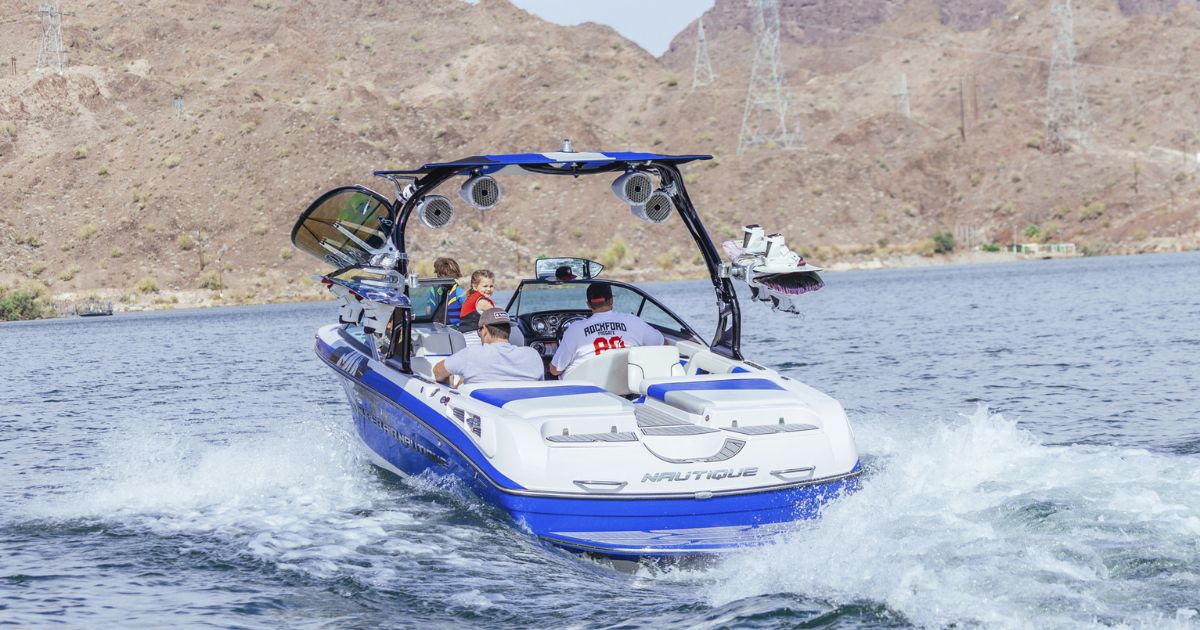
Tower speakers are a category specific to wake boats and ski boats. They mount on the tower structure above the boat and are designed to project sound outward so riders being towed behind the boat can hear the music clearly over wind and water noise. Tower speakers are almost always used in pairs or sets of four and require dedicated amplifier power to work properly.
Marine subwoofers bring bass to the system. Because boats have less enclosed space than a car interior, achieving deep bass requires more power and larger drivers than you might expect. Marine subwoofers are typically used in infinite baffle configurations, meaning they are mounted directly into a flat surface without an enclosure behind them.
Best marine speakers
Best marine head units
Best tower speakers for wake boats
Best marine amplifiers
Best marine subwoofers
Understanding IP Ratings
When you are shopping for marine audio equipment you will see IP ratings listed in the specs. Understanding what these mean helps you buy the right level of protection for your specific application.
IP stands for Ingress Protection. The rating has two digits. The first digit refers to protection against solid particles like dust and the second refers to protection against water. In marine audio the water protection number is what matters most.
IPX5 means the unit can handle water jets from any direction. This is the minimum you want for speakers and head units in a boat environment where spray and splashing are regular occurrences.
IPX6 means the unit can handle powerful water jets. This is appropriate for components that may take direct wave splash or heavy rain exposure.
IPX7 means the unit can be submerged in up to one meter of water for up to 30 minutes. This is relevant for components in very exposed locations on a vessel.
IPX9 is the highest rating and covers high pressure, high temperature water jets. Some premium marine components carry this rating.
As a general rule, the more exposed the mounting location, the higher the IP rating you want for that component.
Boat Types and What They Need
Different types of boats have different audio needs and different installation challenges. Here is how to think about it by boat type:
Wake boats and ski boats are where marine audio gets serious. These boats are specifically built around the activity of being towed behind them, which means the audio system needs to perform both on the boat and for the riders in the water behind it. A proper wake boat system typically includes a quality head unit with zone control, tower speakers in sets of two or four driven by dedicated amplification, cabin speakers for the people on the boat, and often a subwoofer for bass. These are the most audio-focused builds in the marine category and the brands that specialize in them, JL Audio and Rockford Fosgate primarily, build their top marine lines around this use case.
Best audio for wake boats
Pontoon boats are social boats where the priority is comfortable, even coverage across the whole deck so everyone can hear the music from wherever they are sitting. A typical pontoon build focuses on four to six well-placed speakers covering the full deck, a quality head unit with zone or volume control at multiple points, and enough amplifier power to compete with wind noise at cruising speed. Bass is less of a priority on a pontoon than even volume distribution.
Best audio for pontoon boats
Center console and offshore fishing boats need audio that is durable above all else. These boats take serious spray and salt exposure and the audio equipment needs to survive it reliably. The builds are typically simpler, a quality marine head unit, a pair or two of well-protected speakers, and an amplifier in a protected location. Waterproofing rating takes priority over outright audio performance in this category.
Jet skis and personal watercraft have the most limited space and the most extreme water exposure of any marine application. Compact powered speakers or purpose-built PWC audio solutions are the practical option here. Full system builds are not realistic on most personal watercraft.
Tower Speakers: What They Are and How They Work
Tower speakers deserve their own section because they are one of the most misunderstood products in marine audio. A lot of people assume bigger is better and mount the largest tower cans they can find without thinking about what actually makes them work well.
Tower speakers are designed to project sound at a distance, primarily toward riders being towed behind the boat. This means they need to be loud, they need to handle the power required to produce that volume, and they need to be aimed correctly toward the area behind the boat rather than straight out to the sides.
The two key specs for tower speakers are sensitivity and power handling. Sensitivity tells you how loud the speaker will be with a given amount of power. Tower speakers need high sensitivity ratings, typically 90dB or above, because they are fighting a lot of ambient noise. Power handling determines how much amplifier power they can accept. Most quality tower speakers require at least 100 watts RMS per speaker to perform well, and serious systems run significantly more than that.
Tower speakers come in several configurations. Coaxial tower cans are the most common and include a woofer and tweeter in a single housing. Wakeboard tower speakers with LED lighting have become popular and the better brands integrate the lighting without compromising the acoustic performance of the speaker.
JL Audio's M3 & M6 ETXv3 series tower speakers and Rockford Fosgate's M1WL & M2WL series are the benchmarks in this category, with genuine marine-grade construction and acoustic performance that holds up at high volume levels with real amplifier power behind them.
Best tower speakers for wake boats
JL Audio brand hub
Rockford Fosgate brand hub
Wiring and Installation Considerations for Marine Audio
Marine audio installation has a few specific considerations that differ from car audio and getting them right makes the difference between a system that lasts and one that corrodes and fails within a season.
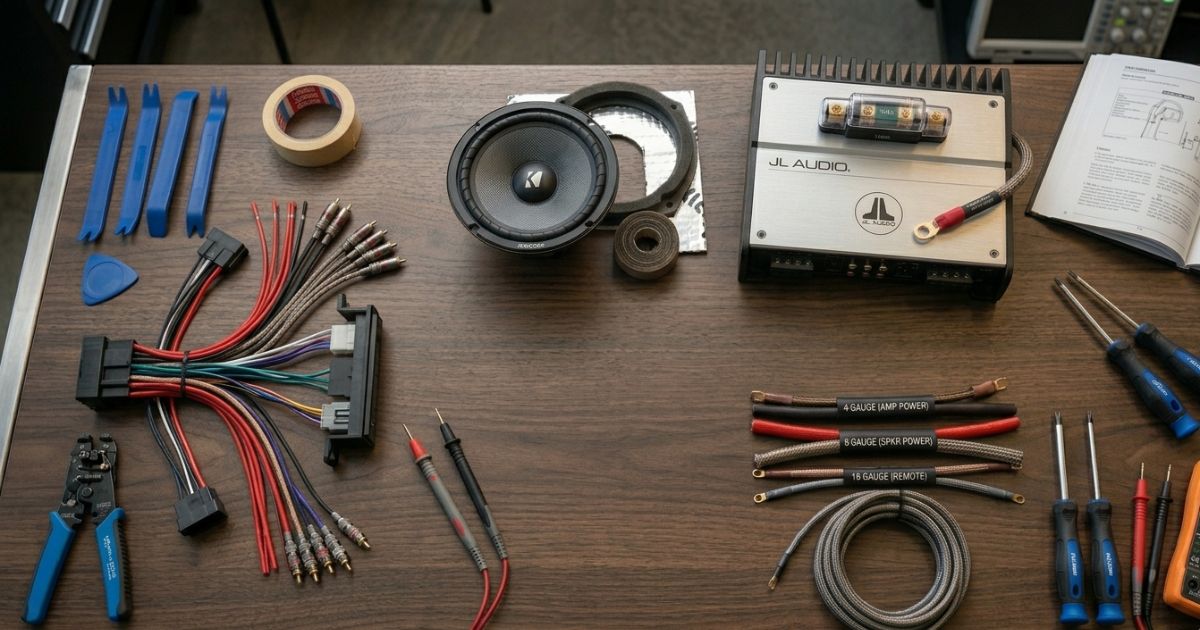
Use tinned marine grade wire for all connections. Standard automotive wire uses bare copper that will corrode quickly in a salt air environment. Tinned copper wire has a protective coating that resists corrosion and is the correct choice for any marine electrical work.
Use heat shrink connectors with adhesive lined interiors for all wire connections. Standard butt connectors allow moisture to wick into the connection over time. Adhesive lined heat shrink connectors seal completely when heated and keep moisture out of the connection permanently.
Mount amplifiers in protected locations whenever possible. Under a seat, in a storage compartment, or in a dedicated electronics bay keeps the amp away from direct spray and UV exposure while still allowing adequate airflow for cooling.
Use dielectric grease on all electrical connections including speaker terminals, power connections, and ground points. This simple step dramatically extends the life of your connections in a salt air environment.
Marine audio wiring tips for saltwater
The Brands Worth Knowing
JL Audio's marine lineup is the benchmark in the category. Their M3, M6, and M7 series speakers step up in materials and performance at each tier, and their marine amplifiers are built to the same standard as their car audio counterparts with full marine grade protection. If you are building a serious system on a wake boat or offshore vessel, JL Audio marine is where the conversation starts.
Rockford Fosgate's M1 & M2 series marine products are trusted by serious builders and come standard on many production wake boats from major manufacturers. Their M series speakers and amplifiers offer excellent performance and genuine marine grade durability. Their tower speaker options are among the most popular in the wake boat market.
Both brands build complete system solutions meaning their head units, amplifiers, and speakers are designed to work together and integrate cleanly. For a builder who wants everything from one brand, both JL Audio and Rockford Fosgate can take you from the head unit all the way to the tower speakers without mixing ecosystems.
JL Audio brand hub
Rockford Fosgate brand hub
Frequently Asked Questions
Can I use regular car speakers on my boat? Technically they will work initially but they will not last. Car speakers use materials that are not designed to handle moisture, UV exposure, or salt air. You will see the cone deteriorate, the surround crack, and the metal components corrode in a single season of regular use. Marine speakers cost more for a reason and the difference in longevity is significant.
Do I need a marine specific amplifier or can I use a car amplifier? For protected installations in a dry compartment, a quality car amplifier can work. But a marine rated amplifier has conformal coated circuit boards that protect against moisture that may find its way into even protected compartments over time. For any installation on a boat that sees regular water exposure, marine rated amplifiers are the right choice.
How do I protect my marine head unit when the boat is stored? Most quality marine head units have a removable face that you can take with you when the boat is stored. This protects the face from UV damage and also provides basic security. Some head units also come with a cover that snaps over the unit when not in use.
How do I prevent corrosion on my marine audio connections? Tinned marine grade wire, adhesive lined heat shrink connectors, and dielectric grease on all connections are the three things that make the biggest difference. Rinsing your entire boat with fresh water after salt water use, including the audio equipment and any exposed connections, also extends the life of everything on board dramatically.
Shop Marine Audio at San Diego Car Stereo
We carry JL Audio and Rockford Fosgate marine lines along with everything you need to build a complete system on any type of vessel. Whether you are putting together a simple setup for a fishing boat or building out a full wake boat system with tower speakers and multiple amplifiers, our team has the experience to help you get it right. San Diego is our backyard and we know what holds up on the water here.


Leave a comment
All comments are moderated before being published.
This site is protected by hCaptcha and the hCaptcha Privacy Policy and Terms of Service apply.