
Car Amplifiers: The Complete Guide
Most people think upgrading their speakers is the key to better sound. And while speakers matter, the amplifier is what actually brings them to life. Without enough clean power behind them, even the best speakers in the world will sound flat, strained, and disappointing. An amplifier is not an optional add-on for serious listeners. It is the engine that makes everything else work the way it should.
This guide covers everything you need to know before buying: the different types of amplifiers, what the specs actually mean, how to match an amp to your speakers or subwoofer, and how to make sure your electrical system can support the build you want.
What Does a Car Amplifier Actually Do?
Your head unit has a built-in amplifier, but it is a weak one. Most factory and aftermarket head units produce somewhere between 15 and 22 watts RMS per channel. That is enough to make sound come out of your speakers but not enough to make them perform anywhere near their potential.
A dedicated external amplifier takes the low level signal from your head unit, boosts it significantly, and sends that amplified signal to your speakers or subwoofer. The result is more volume, more headroom, less distortion at high levels, and a system that sounds controlled and clean instead of strained and compressed.
If you have ever turned up your stereo and noticed it starts to sound harsh or distorted before it gets as loud as you want, that is your head unit running out of clean power. An external amplifier solves that problem completely.
The Different Types of Amplifiers
Not all amplifiers are built for the same job. Understanding the different configurations will help you figure out exactly what your system needs.
A mono amplifier, sometimes called a monoblock, has a single channel and is built specifically to power subwoofers. Mono amps are designed to handle the high current demands of subwoofer loads and are typically stable down to 1 or 2 ohms, which is where they produce their maximum power. If you are adding a subwoofer to your system, a mono amplifier is what you need to power it.
A 2-channel amplifier powers two speakers and is a great option for upgrading a single pair of door speakers or for bridging into a single subwoofer when you do not need the full power of a dedicated mono amp. They are compact, efficient, and versatile.
A 4-channel amplifier is the most common choice for a full speaker upgrade. It powers all four of your door speakers independently, giving each one its own dedicated channel of clean power. Many people also use a 4-channel amp in a configuration where two channels power the front speakers and the remaining two channels are bridged together to power a subwoofer.
A 5-channel amplifier combines a 4-channel amp and a mono amp in a single unit. It powers all four speakers and a subwoofer from one box, which simplifies installation and saves space. For someone building a complete system in one shot, a quality 5-channel amp is often the most practical and cost-effective solution.
A DSP amplifier includes a built-in digital signal processor alongside the amplification. This gives you advanced tuning capabilities like time alignment, parametric EQ, and crossover control all in one unit. DSP amps are popular in builds where a clean, integrated solution is the priority.
Best mono amplifiers for subwoofers
Best 4-channel car amplifiers
Best 5-channel car amplifiers
Best DSP amplifiers for car audio
Class D vs Class AB: What Is the Difference?
When you are shopping for amplifiers you will see Class D and Class AB listed in the specs. This refers to the amplifier's internal design and it affects efficiency, heat output, and size.
Class AB amplifiers are the traditional design. They are highly accurate and produce excellent sound quality but they run less efficiently, meaning more of the power they draw from your electrical system gets converted to heat rather than audio output. Class AB amps tend to run warmer and are physically larger as a result. They are still used in high-end builds where audio accuracy is the top priority.
Class D amplifiers are far more efficient, typically converting 80 to 90 percent of their drawn power into audio output. This means they run cooler, can be built much more compact, and put less strain on your vehicle's electrical system. The majority of modern car audio amplifiers are Class D for these reasons. The stigma that Class D sounds worse than Class AB is outdated. Modern Class D amplifiers from quality brands sound excellent.
For subwoofer applications specifically, Class D is almost always the right choice. For full-range speaker applications, both classes work well and the decision usually comes down to size, budget, and personal preference.
Class D vs Class AB amplifiers: full explanation
What the Specs Actually Mean
Shopping for amplifiers involves a lot of numbers. Here is what the important ones actually tell you:
RMS power is the continuous, usable power the amplifier delivers. This is the only power number that matters. Ignore peak power ratings entirely, they are marketing numbers that tell you nothing useful about real world performance.
Impedance stability tells you the minimum speaker load the amplifier can handle safely. Most amplifiers are rated at 4 ohms and 2 ohms per channel for stereo amps, and 4, 2, and 1 ohm for mono amps. The lower the impedance you run, the more power the amp produces, but you need to stay within what the amplifier is rated to handle or you risk damaging it.
Signal-to-noise ratio tells you how much unwanted noise exists in the amplifier's output relative to the audio signal. A higher number is better. Look for at least 90dB or higher in any quality amplifier.
Total harmonic distortion, listed as THD, tells you how accurately the amplifier reproduces the input signal. Lower is better. Quality amplifiers will be rated at 0.1 percent THD or less.
Crossover controls are the high pass, low pass, and sometimes bandpass filters built into the amplifier. These let you tell the amp which frequencies to send to which speakers. A high pass filter on your door speaker channels keeps low frequencies from trying to come out of speakers that are not built to handle them. A low pass filter on your subwoofer channel keeps high frequencies away from the sub where they do not belong.
What is RMS power?
What is impedance in car audio?
How to set crossover on an amplifier
How to Match an Amplifier to Your Speakers or Subwoofer
Getting the power match right is one of the most important things you can do for both sound quality and equipment longevity. Here is how to think about it:
For speakers, you want an amplifier that delivers somewhere between the speaker's RMS rating and about 150 percent of that rating at your chosen impedance. So if your door speakers are rated for 75 watts RMS at 4 ohms, an amplifier delivering 75 to 100 watts per channel at 4 ohms is ideal. Running a little more power than the speaker's RMS rating is fine as long as you are not clipping the signal. Running significantly less power and then pushing the amp into clipping to get volume is what actually damages speakers.
For subwoofers, the same logic applies. Match your mono amplifier's output at your wiring impedance to the subwoofer's RMS rating, give or take 25 percent. A 500 watt RMS subwoofer pairs well with a mono amp producing 500 to 750 watts at the impedance you are running.
The single most important rule in power matching is this: a properly set amplifier running at its rated power will never damage a speaker rated for that power. Distortion from a clipping amplifier is what blows speakers, not clean power.
How to match amp power to speakers and subwoofers
How to set amp gain the right way
Amplifiers by Budget
Under $200: Solid Entry Level Performance
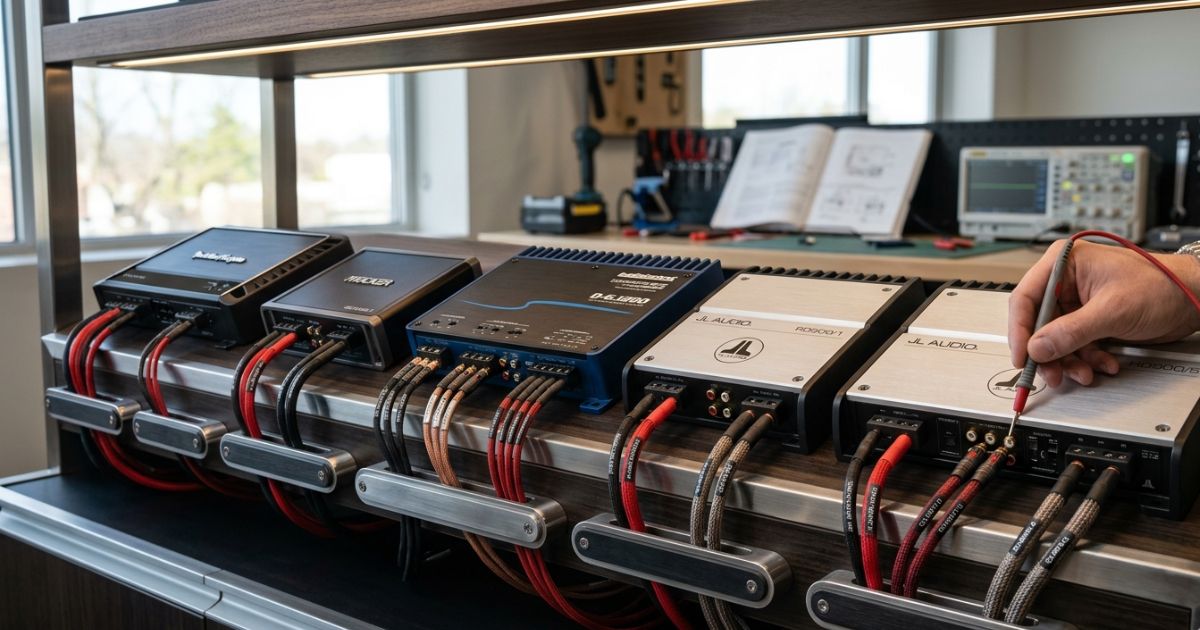
In this range you will find reliable 4-channel and mono amplifiers from Rockford Fosgate's Prime series, Kenwood, and Kicker that will genuinely improve your system over running everything off the head unit. Expect honest power ratings, decent build quality, and good performance for everyday listening. The limitations at this price point are in the components: lighter gauge internal wiring, less robust power supplies, and fewer tuning options. But for a first system upgrade or a secondary build, this tier delivers real results.
Here are some of the units we recommend most often to customers in this range:
Browse our full selection of amplifiers under $200
$200 to $500: Where Build Quality Makes a Real Difference
This is where meaningful jumps in component quality happen. Amplifiers in this range from JL Audio's RD series, Rockford Fosgate's Punch and Prime lines, and Alpine feature better internal components, more accurate power ratings, lower distortion, and more flexible tuning options. If you are building a system around quality speakers or a good subwoofer, this is the tier worth investing in.
These are some of our favorite amplifiers at this price point:
See everything we carry in the $200 to $500 range
$500 and Up: Built for Serious Systems
At this level you are dealing with amplifiers engineered to the highest standard in car audio. JL Audio's HD and XDM series, AudioControl's top lines, and Hertz's reference amplifiers live here. These units feature premium internal components, extremely accurate power output, ultra-low distortion, and in many cases advanced DSP integration. If you are building a system you want to last a decade and sound exceptional, this is where you spend.
Here are the amplifiers we reach for most often at the top of the range:
View our complete lineup of premium amplifiers
The Brands Worth Knowing
JL Audio makes some of the most well-engineered amplifiers in the industry. Their RD series is an exceptional value in the mid-range and their HD and XD series are benchmarks for build quality and accuracy. If you want an amplifier that is going to perform exactly as rated and last, JL Audio is the standard.
Rockford Fosgate covers the full spectrum from their accessible Prime series all the way up to their Power series, which competes with anything at that price point. Their punch series sits in the sweet spot for most builds and offers excellent value for the performance you get.
AudioControl is a brand that serious installers reach for when tuning matters. Their amplifiers often feature advanced signal processing built in and their line output converters and DSP products are among the best in the category. If you are working with a factory head unit or need serious tuning capability, AudioControl belongs in the conversation.
Kenwood and Alpine both make solid amplifiers that offer good value at the entry to mid-range price points. They pair naturally with their own head units and are reliable performers for everyday builds.
Memphis Audio rounds out the lineup with well-built amplifiers at fair prices. Their Power Reference and Street Reference lines are respected in the industry and offer strong performance per dollar at every tier.
JL Audio brand hub
Rockford Fosgate brand hub
What Does My Electrical System Need to Support an Amplifier?
This is the part most people skip and then wonder why their lights dim when the bass hits. Every amplifier draws current from your vehicle's electrical system and if that system cannot keep up, you will have problems.
For modest amplifiers under 500 watts total, your factory alternator and battery will usually handle the load without any upgrades, provided the wiring is done correctly with the right gauge power wire.
For more powerful systems, especially anything above 1,000 watts total, you should consider what is known as the Big 3 upgrade. This involves replacing the three most critical ground and power cables in your vehicle's electrical system with heavier gauge wire, which allows more current to flow freely and significantly improves the stability of your system under load.
For very high powered builds, a second battery dedicated to the audio system is worth considering. This gives the amplifiers a reserve of power to draw from during heavy bass transients without pulling from the same battery your starter relies on.
Big 3 electrical upgrade guide
How to install a car amplifier
Amp wiring kit sizing guide
Do I Need One Amplifier or Multiple?
This depends on your goals and your budget. There is no single right answer.
A single 5-channel amplifier powering all four speakers and a subwoofer is the cleanest, simplest solution and works well for most complete system builds. One amp, one power wire run, straightforward installation.
Separate amplifiers for speakers and subwoofer give you more flexibility. You can choose the best mono amp for your subwoofer independently of the best 4-channel for your speakers, and you can upgrade one without replacing the other. The tradeoff is more complex installation and more current draw.
If you are just upgrading your speakers and not adding a subwoofer yet, a single 4-channel amplifier is all you need for now. You can always add a mono amp for a subwoofer later without changing anything you have already installed.
Frequently Asked Questions
Will adding an amplifier drain my battery? A properly installed amplifier running off a healthy charging system will not drain your battery while the engine is running. The alternator replenishes what the amp draws in real time. Where people run into trouble is with undersized wiring or a weak alternator that cannot keep up with the demand. Both are installation issues, not inherent problems with amplifiers.
Can I install an amplifier myself? Yes, with patience and the right information. The basic process involves running a power wire from the battery, grounding the amp to bare metal near its mounting location, running RCA cables from the head unit, and connecting speaker outputs. If you are not comfortable with automotive wiring, a professional installation is money well spent.
What is gain and how do I set it? Gain is not a volume control. It is a sensitivity adjustment that matches the amplifier's input level to the output level of your head unit. Setting gain correctly ensures the amp is receiving the strongest possible clean signal before it amplifies it. Set too high, you amplify distortion from the head unit along with the music. Set correctly, the system sounds clean at any volume.
How to set amp gain the right way
How to fix ground loop noise
Shop Amplifiers at San Diego Car Stereo
We carry JL Audio, Rockford Fosgate, AudioControl, Kenwood, Alpine, Memphis Audio, and more. Every amplifier we sell is one our install team has put into real builds. If you are not sure which type, channel count, or power level is right for your system, reach out. Matching the right amplifier to the right system is one of the things we do best, and we are glad to help you get it right the first time.

Leave a comment
All comments are moderated before being published.
This site is protected by hCaptcha and the hCaptcha Privacy Policy and Terms of Service apply.