

Car Speakers: The Complete Buying Guide
Your factory speakers were not designed to impress you. They were designed to meet a cost target. Most vehicles roll off the assembly line with speakers built to a bare minimum standard, using cheap paper cones, small magnets, and limited power handling. They make sound, but they do not make music the way it was meant to be heard.
Upgrading your car speakers is one of the most noticeable improvements you can make to your vehicle. Unlike a lot of audio upgrades where the difference is subtle, swapping factory speakers for quality aftermarket ones is immediately obvious. More detail, more clarity, better bass response, and a soundstage that actually feels like the music is surrounding you rather than just coming out of a box in your door.
This guide covers everything you need to know before buying: the different types of speakers, what the specs mean, how to size them for your vehicle, and how to get the most out of whatever budget you are working with.
The Different Types of Car Speakers
Understanding the different speaker types is the first step to making the right choice for your vehicle and your goals.
Coaxial speakers, sometimes called full-range speakers, combine multiple speaker elements into a single unit. The woofer handles the low and mid frequencies while a tweeter mounted in the center of the cone handles the highs. They are the most common type of aftermarket speaker, the easiest to install, and the most affordable. For most people doing a straightforward factory speaker replacement, coaxial speakers are the practical and cost-effective choice.
Component speakers separate those elements into individual drivers: a dedicated woofer, a separate tweeter, and an external crossover that divides the audio signal and sends the right frequencies to the right driver. Because each driver is optimized for its specific frequency range, component systems produce noticeably better sound quality than coaxial speakers. The tweeters can also be mounted at ear level in your A-pillar or sail panel, which dramatically improves the soundstage. The tradeoff is more complex installation and a higher price.
Convertible speakers give you the best of both worlds. They ship with the tweeter mounted in the center of the woofer like a traditional coaxial, but the tweeter can be removed and mounted separately to turn the set into a component system. If you are not sure which direction you want to go with your install, or if you want the option to upgrade your setup later without buying new speakers, convertible speakers remove that decision entirely. Memphis Audio's M Series and Rockford Fosgate's new V2 Punch series are good examples of this done well.
Tweeters are small high-frequency drivers that handle the crisp, detailed top end of the audio spectrum. They are typically sold as part of a component set but can also be added individually to complement existing speakers in certain builds.
3-way speakers add a dedicated midrange driver to the mix, either as part of a coaxial design or a component system. The additional driver gives you more detailed midrange reproduction, which is where a lot of the texture and presence in vocals and instruments lives.
Component vs coaxial speakers: which should you buy?
Speaker Sizes: Finding What Fits Your Vehicle
Before you fall in love with a specific speaker, you need to know what size opening you are working with. Car speakers come in standard sizes and your vehicle's door panels are built around specific cutout dimensions.
The most common sizes are 3.5 inch, 4 inch, 5.25 inch, 6.5 inch, 6x8 inch, 6x9 inch, and a handful of less common sizes in between. The 6.5 inch is the most popular size in the industry because it fits in the door panels of the vast majority of vehicles built in the last two decades.
You can find your vehicle's factory speaker sizes using an online fit guide or by checking the specifications for your year, make, and model. Most reputable retailers including us will have fitment information available so you are not guessing.
One important note: fitting a speaker into the opening does not always mean it will clear the window glass or door hardware behind the panel. Mounting depth matters too. A speaker with too much depth will contact the window when it rolls down, which is a problem you want to avoid before you buy.
Best 6.5-inch car speakers
Best 6x9 car speakers
Best 5.25-inch car speakers
What the Specs Actually Mean
Sensitivity is one of the most important specs on a speaker and one of the most overlooked. It tells you how loud the speaker will be given a specific amount of power, measured in decibels. A speaker with a sensitivity of 92dB will be noticeably louder than one rated at 88dB when both are given the same amount of power. If you are running your speakers off a head unit without an external amplifier, higher sensitivity speakers will give you more volume and clarity from the limited power available. If you are running a powerful amplifier, sensitivity matters less because you have power to spare.
RMS power handling is the continuous power the speaker can handle safely over time. This is the number to use when matching speakers to an amplifier. Match the amplifier's output to the speaker's RMS rating and you will get great results. Running significantly more power than the speaker's RMS rating for extended periods can damage the voice coil.
Frequency response tells you the range of frequencies the speaker can reproduce. A wider range is generally better, particularly on the low end. A speaker that reaches down to 50Hz will reproduce more bass than one that bottoms out at 80Hz, all else being equal.
Impedance tells you the electrical resistance of the speaker, measured in ohms. Most car speakers are 4 ohm. Running speakers at the impedance your amplifier is rated for ensures you get the power output you expect without putting excess stress on the amp.
What is sensitivity rating in speakers?
What is RMS power?
What is impedance in car audio?
Do I Need an Amplifier for My Speakers?
You do not need an amplifier to upgrade your speakers but you will get significantly better results with one. Here is the honest breakdown:
Running aftermarket speakers off your head unit's built-in power will sound better than your factory speakers. The speakers themselves are higher quality drivers and they will show that improvement even with modest power behind them. For someone who just wants a noticeable upgrade without adding complexity or cost, head unit power plus quality speakers is a legitimate approach.
Adding an external amplifier takes those same speakers and lets them perform at their actual potential. More clean power means more headroom, less distortion at higher volumes, better dynamics, and a more controlled, accurate sound. If you are investing in a quality set of component speakers especially, pairing them with a dedicated 4-channel amplifier is the right way to do it.
The short version: speakers plus an amp is always better than speakers alone. How much better depends on the quality of the amp and how hard you push the system.
Best 4-channel car amplifiers
Car amplifiers: the complete guide
Component vs Coaxial: Which is Right for You?
This is the question we get asked more than any other in the speaker category. The answer depends on what you are trying to accomplish and how involved you want the installation to be.
Coaxial speakers are the right choice if you want a clean, straightforward upgrade that installs directly into your factory locations with minimal modification. They sound significantly better than factory speakers, they are easy to install, and they are available at every price point. For most daily drivers and casual listeners, a quality set of coaxial speakers is all you need.
Component speakers are the right choice if you are serious about sound quality and want the best possible result from your front stage. The ability to position the tweeters at ear level makes a dramatic difference in imaging and soundstage. If you have ever been in a car where the music seemed to float in front of you rather than just come out of the doors, that was almost certainly a component system doing its job. The installation is more involved and the price is higher, but the improvement in sound quality is real and significant.
A common approach is to run a component system in the front doors where soundstage matters most and coaxial speakers in the rear where they are mostly providing fill. This gives you the best of both worlds without paying for a full component system front and rear.
Component vs coaxial speakers: full breakdown
Speakers by Budget
Under $200: A Real Upgrade Over Factory
In this range you will find solid coaxial speakers from Kicker's KS series, Kenwood, and Pioneer that are a genuine step up from anything that came in your vehicle from the factory. Expect better cone materials, improved tweeter quality, and noticeably more detail and clarity. The limitations are in power handling and build quality at the upper end of their range. For someone who wants a simple plug and play upgrade without spending much, this tier delivers exactly that.
Here are some of the units we recommend most often to customers in this range:
Browse our full selection of speakers under $200
$200 to $300: Where the Jump in Quality Gets Real
This is where component systems become accessible and coaxial speakers start using significantly better materials. Speakers from JL Audio's C1 and C2 series, Rockford Fosgate's Punch and Power series, Hertz, and Kicker's upper lines feature better cone materials, stronger motor structures, and more refined crossover designs. If you are pairing your speakers with an external amplifier, this is the tier where that investment starts to pay off clearly.
These are some of our favorite speakers at this price point:
See everything we carry in the $200 to $500 range
$500 and Up: Audiophile Grade Performance
At this level you are dealing with speakers built to a standard where every component is chosen for performance rather than cost. Focal, Hertz's Mille and MLK series, JL Audio's C3 and C5 series, and Rockford Fosgate's Power series T top tier all live here. These speakers reveal detail in music that cheaper drivers simply cannot reproduce and they reward a quality amplifier and careful tuning with genuinely exceptional results.
Here are the speakers we reach for most often at the top of the range:
View our complete lineup of premium speakers
The Brands Worth Knowing
JL Audio builds some of the most refined speakers in the car audio market. Their C1 series offers exceptional value in the entry to mid-range and their C2, C3, and C5 series step up in both materials and performance at each tier. Consistent build quality and accurate sound make them a go-to recommendation for builds of all sizes.
Rockford Fosgate covers the full range from accessible to high performance. Their Punch series coaxials are among the most popular entry-level speakers in the industry and their Power series component sets compete with anything at that price point.
Kicker makes reliable, well-built speakers at every price point. Their KS and KSS series coaxial and component lines are strong performers and excellent value, particularly for someone building their first upgraded system.
Hertz is a brand that audiophile-focused builders know well. Their speakers are engineered to a very high standard with premium materials and precise crossover design. Their Energy and Cento series offer remarkable performance in the mid-range and their Mille and MLK series are genuinely reference-level drivers.
Focal is a French brand with a long history in high-end audio. Their car speakers bring that same commitment to acoustic engineering into the automotive world. If you want the best possible sound and are willing to pay for it, Focal belongs in the conversation.
JL Audio brand hub
Rockford Fosgate brand hub
Kicker brand hub
Installation: What to Expect
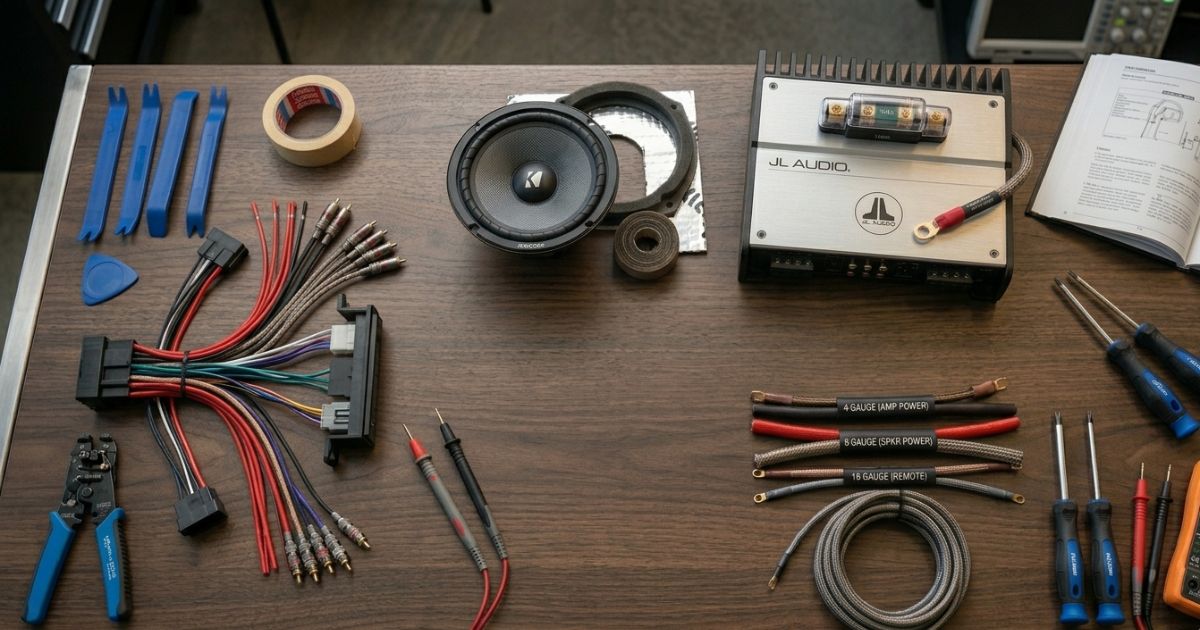
Replacing coaxial speakers is one of the most approachable DIY projects in car audio. In most vehicles it involves removing the door panel, unplugging the factory speaker, unscrewing it from the mounting location, and reversing the process with the new speaker. Basic tools and a couple of hours is usually all it takes.
Component speakers add some complexity. The woofer installs in the door like a coaxial but the tweeter needs to be mounted separately, typically in the factory tweeter location, the A-pillar, or a sail panel mount. The external crossover also needs to be mounted somewhere inside the door or nearby. None of it is beyond a capable DIYer but it takes more planning and time than a simple coaxial swap.
A few things that make a real difference in the final result regardless of which speaker type you choose: sound deadening material on the inner door skin reduces road noise and gives the speaker a better acoustic environment to work in, a speaker baffle or foam gasket creates an airtight seal between the speaker and the door panel which improves bass response, and proper break-in time on new speakers lets the suspension loosen up and the speaker reach its full performance over the first several hours of use.
How to install door speakers
Sound deadening guide for cars
Frequently Asked Questions
How do I know if my speakers are blown? The most common signs are distortion or crackling at any volume level, a lack of high frequency detail, or no sound at all from one channel. You can also test a speaker by gently pressing on the cone with your fingertips. A healthy speaker cone should move smoothly without any scraping or grinding sensation. If you feel or hear resistance, the voice coil has likely been damaged.
Can I mix speaker brands in my car? Yes, but be mindful of matching sensitivity ratings if possible. Significant differences in sensitivity between your front and rear speakers can make balancing the system more difficult. Matching brands or at least matching sensitivity levels front to rear will give you a more consistent sound across the vehicle.
Do rear speakers matter as much as front speakers? For sound quality purposes, no. The front speakers carry the most important audio information including the soundstage and imaging. Rear speakers mostly provide ambience and fill. Spending the majority of your speaker budget on the front stage and using a more modest rear speaker is a completely legitimate approach and what most serious builders do.
How long do car speakers last? A quality speaker installed correctly and driven within its rated power range should last many years without issue. The most common causes of premature speaker failure are too much power, too little power combined with heavy clipping from a driven amplifier, and physical damage from water or impact.
Shop Car Speakers at San Diego Car Stereo
We carry JL Audio, Rockford Fosgate, Kicker, Hertz, Focal, Kenwood, and more. Every speaker we sell is one our install team has worked with in real builds. Whether you are looking for a simple plug and play coaxial upgrade or a full component system for a serious front stage, we can help you find the right fit for your vehicle and your goals.

Leave a comment
All comments are moderated before being published.
This site is protected by hCaptcha and the hCaptcha Privacy Policy and Terms of Service apply.